
On Wednesday evening, Vincent van Gogh’s Châtaigniers en fleurs sold at Sotheby’s in New York for $190.4 million, including fees. The price broke the artist’s previous auction record of $117.2 million, set in 2022. Until the day before, it was unclear whether the painting would go to auction at all. The heirs of its former owner, German Jewish publisher Samuel Fischer, had challenged a sale made by the family in 1936.
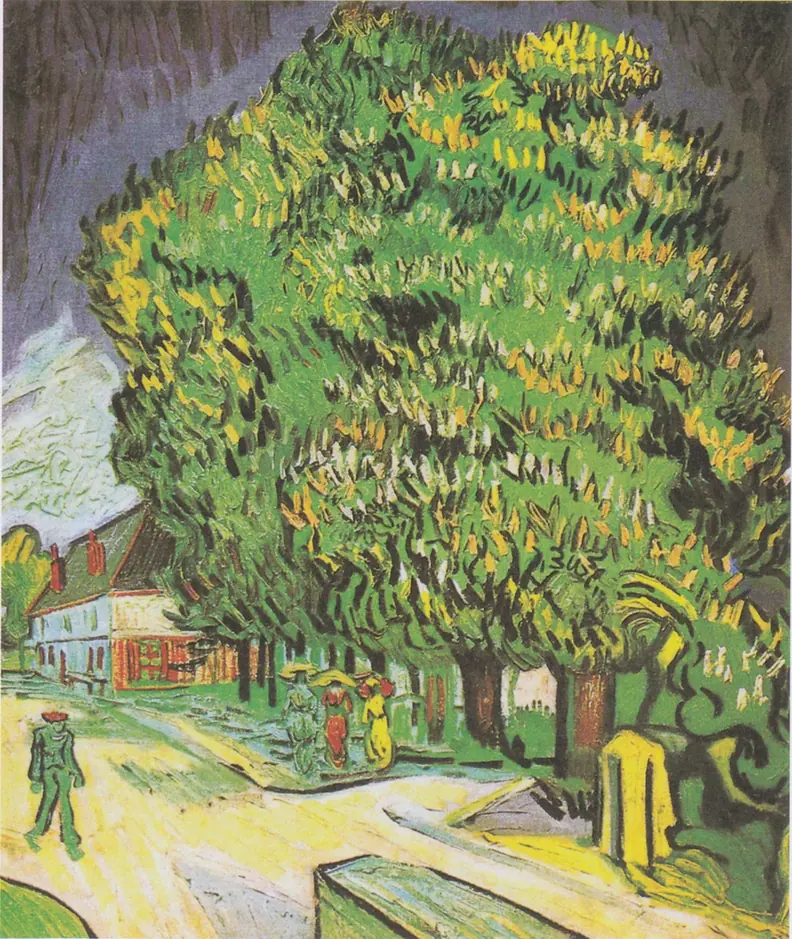

The painting itself offers an almost ordinary scene. Chestnut trees in blossom stretch across a village street, their branches crowded with pale flowers. A few figures pass beneath them, small against the dense greens and blues. Van Gogh painted it in Auvers-sur-Oise in May 1890, shortly after leaving the asylum at Saint-Rémy-de-Provence. He died that July. For much of the past half-century, the work remained in private hands, largely beyond public view.
Samuel Fischer acquired the painting in 1909. After his death in 1934, it remained in the family. The provenance also records that Gottfried Bermann Fischer, Samuel’s son-in-law and the man running the family publishing house, had deposited the painting with the Paul Cassirer gallery in Amsterdam in 1932 or 1933. In 1936, it was acquired by Henriette and Marcel Kapferer. Earlier in its journey, the painting passed through the hands of Jo van Gogh-Bonger, whose role in building his reputation we explore in How Did Van Gogh Become Famous?
It is that 1936 transaction which Fischer’s descendants have questioned. They argue that Nazi persecution had placed the family under financial pressure and that the painting was sold under duress. Sotheby’s initially said its research had not established that the sale was forced.
On 17 November, the auction house announced that the Fischer heirs and the Blaquier-Arrieta family, who had owned the painting since 1975, had reached an agreement. Sotheby’s acknowledged the painting’s complex Nazi-era history and the suffering endured by the Fischer family during the Holocaust. It described the settlement as a “mutually satisfactory resolution”. Its financial and legal terms have not been made public.
At auction, bidding reached $165 million before fees brought the total to $190.4 million. The painting had been expected to achieve around $180 million at the hammer. Its new record is substantial, even though the hammer price fell short of that estimate.
The 1936 sale took place in the Netherlands, four years before German occupation. Yet the Fischer heirs’ claim concerned pressures already facing the family under Nazi persecution. The agreement has allowed the painting to change hands, but the circumstances of that earlier sale remain an important part of its history. A provenance record can tell us when a painting changed owners. Understanding how freely that decision was made is a more difficult matter.
Further reading
- Sotheby’s — Châtaigniers en fleurs, Lot 5
- Reuters — Van Gogh’s painting sells for a record $190.4 million, 19 November 2026
- The Art Newspaper — Sotheby’s makes last-minute deal to sell $180m Van Gogh painting, 17 November 2026
- The Art Newspaper — Van Gogh painting sells for record $190m at Sotheby’s, 19 November 2026
- Artnet News — Van Gogh Painting Sells for Record $190.4 Million in New York, 18 November 2026
- ARTnews — Sotheby’s, Blaquier-Arrieta Family Reach Deal With Fischer Heirs, Clearing Way for $180 M. Van Gogh Sale, 17 November 2026
Related
Where Is the Salvator Mundi Now? The Price of Disappearing