
At Christie’s in New York, the bidding stopped at $400 million. The buyer’s premium would bring the bill to $450,312,500. The auction had taken nineteen minutes; the painting, barely sixty-six centimetres high, was small enough to be carried through a doorway without anyone ducking. Nine years later, the obvious question has an unsatisfying answer. Where is the Salvator Mundi now? As of 14 November 2026, its precise location has not been independently verified or publicly documented. It has not been exhibited publicly since its 2017 sale. A named source said in 2024 that it was in storage in Geneva; later reporting described a possible future museum in Riyadh. Neither amounts to a confirmed sighting.

There is an irony in the precision of the money. Christie’s can tell us the total to the last dollar, and exactly how long the auction lasted. It can name the specialist who placed the winning telephone bid. What cannot be named with comparable confidence is the room in which the painting is hanging, if it is hanging at all.
We are accustomed to expensive art being inaccessible. Collectors put pictures in private houses; museums negotiate loans for years. Salvator Mundi is different in one respect. Its price was made spectacularly public at the very moment its physical future became private. The record price is no longer merely an episode in the picture’s history. It has helped obscure the more difficult matter of what, exactly, was bought.
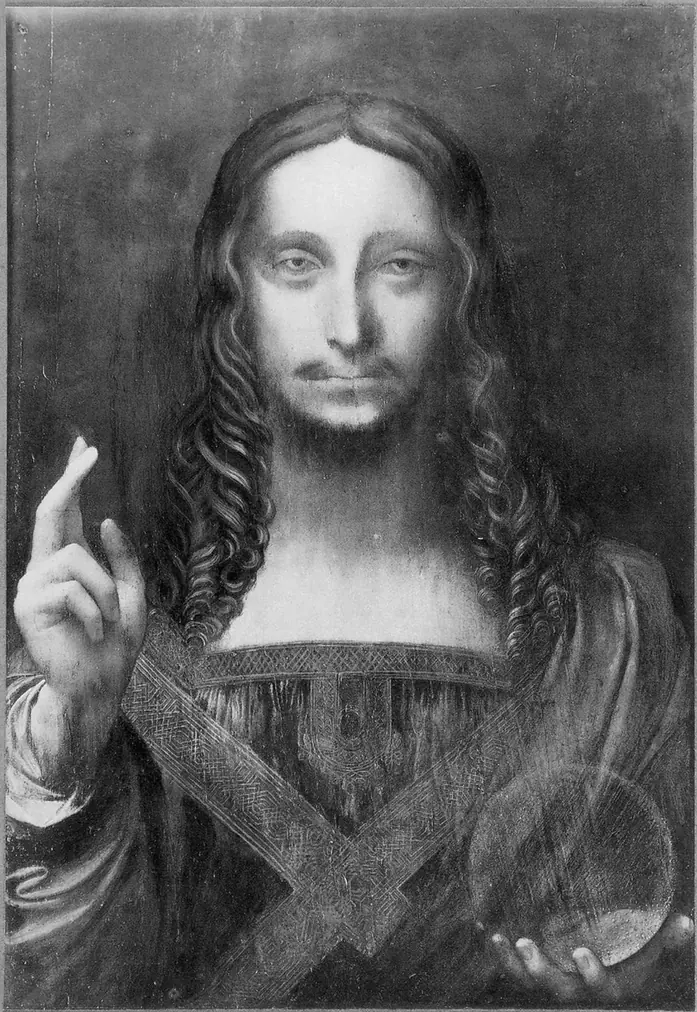
The painting shows Christ facing the viewer. His right hand offers a blessing; his left supports a clear sphere that seems both weightless and improbably heavy. The blue garment is crossed by ornamental bands. Above it, his face hovers in a soft, damaged half-light. He looks present and faintly unavailable, a fitting effect for a picture whose owner has made it difficult to see at all.
Its material history is much less serene. The panel was known in the Cook collection in Britain around 1900, when it was associated with Leonardo’s circle rather than confidently assigned to him. At Sotheby’s in London in 1958, it sold for £45. The much-repeated suggestion that the very same panel once belonged to Charles I is not a continuous, securely established chain of ownership. Old inventories describe paintings of Christ attributed to Leonardo; scholars disagree about which surviving version, if any, they identify. That distinction tends to evaporate when a provenance is compressed into an auction-room biography.
The panel resurfaced at a small New Orleans auction in 2005. A consortium including the dealer Robert Simon bought it for $1,000 plus commission, bringing the recorded total to $1,175. The number has become a favourite before-and-after trick: a four-figure purchase transformed into a nine-figure sale. Between the two transactions came years of conservation work and a bruising argument about authorship.
Dianne Dwyer Modestini, the conservator who worked on the painting, recalled receiving it in April 2005. In her account published as “The Leonardo Effect,” she described a split running through the panel and serious damage around Christ’s head. The picture had been varnished unevenly, and recent retouches complicated what could be seen of the earlier paint. At first she did not recognize a Leonardo. Her husband Mario, also a conservator, reportedly judged it the work of a great artist but thought of a generation after Leonardo.
That is a rather more revealing beginning than the usual rediscovery fable. The painting did not emerge from obscurity looking like the image that went on the auction block. Over years, Modestini removed discoloured coatings and later paint, treated structural problems and reintegrated losses. Images of the panel at different stages of treatment show how dramatically the face and surrounding darkness changed. To call this simply a cleaning would misdescribe the work. To say that the entire picture was invented by the restorer would be equally careless.
Modestini has consistently pointed to areas of original paint that she considers exceptionally preserved, particularly the blessing hand. Technical evidence matters here. In a 2020 study in Heritage Science, Nica Gutman Rieppi and her colleagues analysed minute samples of paint, identifying the pigments and the sophisticated layering beneath the visible surface. Their findings tell us something quite concrete about how the panel was made. Pigments and layers, however revealing, cannot identify the painter of every stroke. A material can be compatible with Leonardo’s practice without settling the attribution.
The restoration also raises an awkward question for anyone trying to judge the painting from reproductions. Which image are we looking at? A photograph before treatment documents losses and earlier interference. An auction photograph records a surface after years of close, skilled intervention. Both are images of the same object. They are not interchangeable evidence of the artist’s hand.
In 2011, London’s National Gallery exhibited the painting in Leonardo da Vinci: Painter at the Court of Milan, a decision that lent the attribution extraordinary institutional weight. By 2017, Christie’s was offering the panel unequivocally as a Leonardo. In a sale devoted to post-war and contemporary art, that name became the event. The careful vocabulary of attribution, usually weighed in catalogues and argued over in seminar rooms, had to compete with a much simpler proposition: the last Leonardo available to buy.
But the scholars did not all sign the same verdict. The Leonardo specialist Martin Kemp remains a forceful advocate. In a 2024 essay for the British Academy, he located the artist’s intelligence in the curling hair and in the handling of the transparent sphere. He also discussed the eyes, whose blurred contours he relates to Leonardo’s studies of vision. It is a serious argument, founded on close looking and decades of study, not just on the thrill of discovery.
Carmen Bambach, a leading Leonardo scholar associated with the Metropolitan Museum of Art, has taken a narrower view. She has assigned much of the surviving paint to Leonardo’s pupil Giovanni Antonio Boltraffio, while allowing passages by the master. Frank Zöllner has questioned whether the panel’s condition and later treatment permit an unqualified attribution at all. The word fake flattens a disagreement that deserves better. Renaissance workshops were collaborative places. A design could be Leonardo’s while its execution remained largely someone else’s work. The distinction matters when hundreds of millions of dollars rest on a single name.
Something curious happened at the Louvre. The Paris museum wanted the picture for its great Leonardo exhibition of 2019–20. There was room for it in the plans, and French arrangements for insuring the loan were drawn up. Yet it did not appear. In October 2019, curator Vincent Delieuvin was still expressing hope that the work might arrive. It never did.
For a time, the absence was explained in the press as a problem of authenticity. Ben Lewis, who examined the picture’s market history in The Last Leonardo, reported doubts within the Louvre and questioned the way its earlier exhibition at the National Gallery had been used to support the sale. The suggestion was persuasive because the painting was so heavily restored and its attribution already disputed. It was also incomplete.
In 2018, Louvre specialists had examined the picture scientifically. A small volume prepared by the museum in December 2019, subsequently withheld from normal distribution, argued for an autograph Leonardo. As Alison Cole reported in The Art Newspaper, the museum’s then director Jean-Luc Martinez wrote in his preface that the study confirmed the attribution. Delieuvin’s essay likewise favoured Leonardo’s own hand. It is difficult to reconcile that evidence with the tidy story that Louvre experts simply rejected the painting.
A different explanation surfaced through reporting on negotiations between France and Saudi Arabia. A 2021 French documentary alleged that the owner wanted Salvator Mundi displayed beside the Mona Lisa with equivalent status, and that the conditions were refused. That account has been repeated widely. It should remain an attributed claim rather than a settled institutional finding. The Louvre has not issued a single, fully documented public explanation of why the loan failed. Stranger still, the Mona Lisa itself was absent from the 2019 Leonardo exhibition; the Louvre kept it on its usual public route for reasons of access and capacity.
The Paris absence followed an earlier one in Abu Dhabi. Louvre Abu Dhabi had announced a display for 18 September 2018. On 3 September, the emirate’s Department of Culture and Tourism postponed the unveiling without announcing a replacement date or an explanation. A date had been announced, then removed from the calendar. Visitors never saw the panel.
Then came the location stories, each more vivid than the next. In June 2019, the art-market commentator Kenny Schachter reported that Salvator Mundi had been taken aboard the Saudi crown prince’s yacht Serene. The image was irresistible: Christ blessing the world from a superyacht. But Schachter was reporting what unnamed sources told him. When The Art Newspaper later tracked the yacht’s movements, it could track a boat, not a painting. The story circulated far more securely than its evidence.
In August 2024, another possibility was offered by someone prepared to be named. Bernard Haykel, a Princeton professor described as close to Mohammed bin Salman, told the BBC that the panel was in storage in Geneva. He said the crown prince intended eventually to show it in a large museum in Riyadh. In October 2025, Melissa Gronlund reported in The Art Newspaper that the picture was understood to be destined for a Riyadh museum. The report points to a possible future home. It does not establish where the painting is today. The Geneva account has not been accompanied by a public storage record. No newly announced exhibition resolves the matter as of this article’s research date.
There are understandable reasons why a private owner might keep a fragile, exceptionally valuable painting out of circulation. Its walnut support has suffered damage. Security and insurance questions are not trivial, and no buyer is obliged to lend an artwork simply because the public would like to see it. A painting's absence is not proof that it has deteriorated or that somebody fears the judgment of specialists.
The auction price takes seconds to check. Christie’s recorded $450,312,500, and the figure has been repeated so often that it now feels as familiar as the painting’s face. Looking again at the face itself is another matter. The photographs document different stages of treatment; the Louvre’s scientific study reaches most readers through reports of a book that was never distributed in the usual way. Specialists can examine those records, but the painted surface remains beyond independent, fresh inspection. Every year it stays away, the earlier encounters with the object have to carry more weight.
This may be the most peculiar achievement of the 2017 sale. The auction made Salvator Mundi visible almost everywhere, as a headline and an image. Since then its actual physical presence has become increasingly hard to pin down. The public owns the price, but not the opportunity to inspect the thing for which it was paid.
On the familiar photograph, the sphere rests on Christ’s open palm. There are tiny lights caught inside it, while the blue robe behind seems to continue through its clear surface. Somewhere, the original panel still has that small, stubborn patch of reflected light. We have the photograph. The room beyond it remains dark.
Further reading
- Martin Kemp, “Salvator Mundi: Leonardo da Vinci’s missing masterpiece?”, The British Academy, 15 November 2024
- Alison Cole, “What the Louvre’s scientific examinations of the Salvator Mundi really revealed—according to the museum’s own book”, The Art Newspaper, 13 April 2021
- Matthew Landrus and Kabir Jhala, Salvator Mundi timeline, The Art Newspaper, 18 November 2022
- Nica Gutman Rieppi et al., “Salvator Mundi: an investigation of the painting’s materials and techniques”, Heritage Science, 2020
- Ben Lewis, The Last Leonardo, 2019.
Watch the film
Salvator Mundi: Why Did a Damaged Painting Sell for $450 Million? ↗
The film follows the painting’s damaged surface and extraordinary sale; this essay takes up what happened after it disappeared from public view.