
There's something unexpectedly fragile about Kazimir Malevich's Black Square. In reproductions, it looks so definite: a dark shape against a white ground, apparently needing no further explanation. But look at the 1915 painting closely and the black begins to break apart. Fine cracks spread across its surface, revealing flashes of colour underneath. The square has aged badly. Or perhaps it has simply aged in a way we were never supposed to notice.
I find those cracks more interesting than the geometry. They make it difficult to treat the painting as the immaculate beginning of something entirely new. There is another history underneath that black paint, and some of it is quite literally showing through.
There are also four surviving Black Squares.
That detail tends to surprise people. We speak of the painting as though it were a single, irreplaceable object, yet Malevich returned to the same motif several times between 1915 and the early 1930s. The versions differ in size, surface and circumstances. One was made for an exhibition after the original had already begun to deteriorate.
So which one is Black Square?
The first appeared in December 1915 at the Last Futurist Exhibition of Paintings 0.10 in Petrograd. Malevich showed thirty-nine works, many consisting of geometric shapes floating against pale backgrounds. They were unlike the portraits or landscapes visitors might have expected to encounter. He had begun calling this new direction Suprematism. The wider question of who painted the first abstract painting is a rather more complicated story.
Why Did Malevich Hang It in the Corner?
But it was the placement of Black Square that made the strongest statement.
In the surviving photograph of the exhibition, the painting hangs high across the corner where two walls meet. In Russian Orthodox homes, this position was traditionally reserved for a religious icon. Malevich had placed his black square where an image of Christ or the Virgin might once have stood.
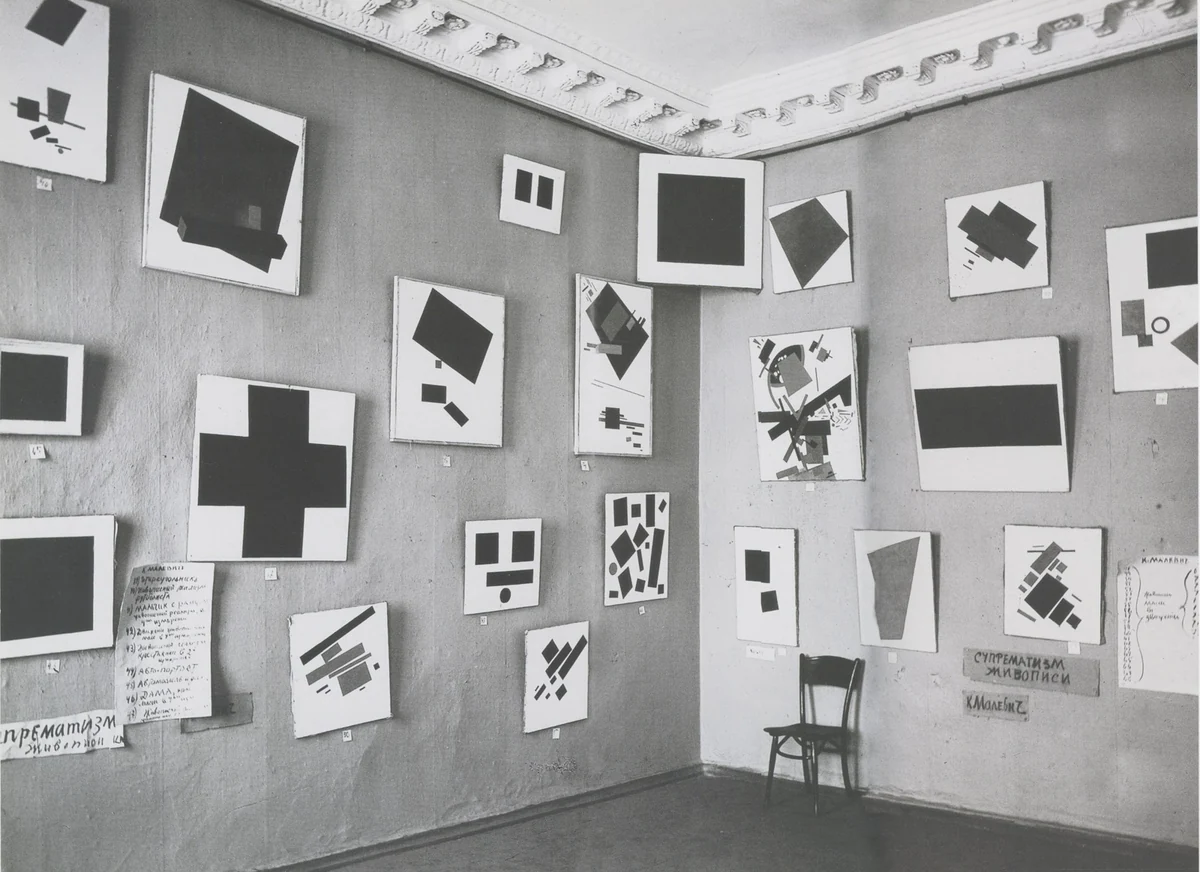

It must have been an arresting sight. An empty-looking geometric form occupying a place associated with devotion.
Malevich later described Suprematism as the supremacy of pure feeling in art. He wanted painting to abandon its obligation to represent recognizable things. The square was not meant to depict an object in the world. It proposed another way of understanding what a painting could be.
Even the title was less straightforward than it now seems. In the 0.10 catalogue, the work appeared as Quadrangle. And despite its reputation for mathematical simplicity, its sides are slightly irregular. The corners are not perfect right angles.
The painting is much less precise than the idea we have made of it.
There is another small complication. Although the original was painted in 1915, Malevich dated it 1913. He traced the motif back to his work on the Futurist opera Victory over the Sun, for which he had designed a black-and-white curtain.
He was already rewriting the square's history.
Perhaps that shouldn't surprise us. Artists are often unreliable historians of their own beginnings, particularly when they want those beginnings to mark a break with everything that came before.
What Is Under the Black Square?
In 2015, researchers at Moscow's State Tretyakov Gallery examined the painting using technical imaging. Their discoveries made the supposedly pure black surface considerably more crowded.
Beneath it were two earlier geometric compositions, both containing colour. The researchers identified different black paints, fingerprints in the white border and faint pencil writing. The inscription appeared to allude to a racist joke from an 1897 publication by the French writer and humorist Alphonse Allais, although the precise interpretation remains a matter of scholarly discussion.
It's an uncomfortable detail, and one that complicates the familiar story of a painting born from pure abstraction.
The black had not arrived on an untouched canvas. Malevich had painted over earlier work. What looks like a decisive act of artistic reduction involved a process of revision, covering and reconsideration.
The painting that supposedly left the visible world behind was carrying pieces of another one underneath.
Why Are There Four Black Squares?
The later versions have their own peculiar histories.
Around 1923, Malevich made a much larger Black Square, measuring 106 centimetres on each side. Now in the State Russian Museum in St Petersburg, it was associated with a group of works prepared in connection with the 1924 Venice Biennale, alongside a black circle and a black cross. The museum's records indicate that it was not actually exhibited there.
Then, in 1929, came the version I find particularly revealing.
The original was already badly cracked. Malevich was preparing for a retrospective at the Tretyakov Gallery in Moscow, and a new Black Square was painted for the occasion. Accounts of its production describe a surprisingly practical solution to a problem that might otherwise have seemed philosophical.
The first painting was deteriorating. Another could be made.
The 1929 canvas measures 80 by 80 centimetres and looks markedly different from its predecessor. Its surface is smoother, its black more even. The fractured skin of the 1915 painting has disappeared.
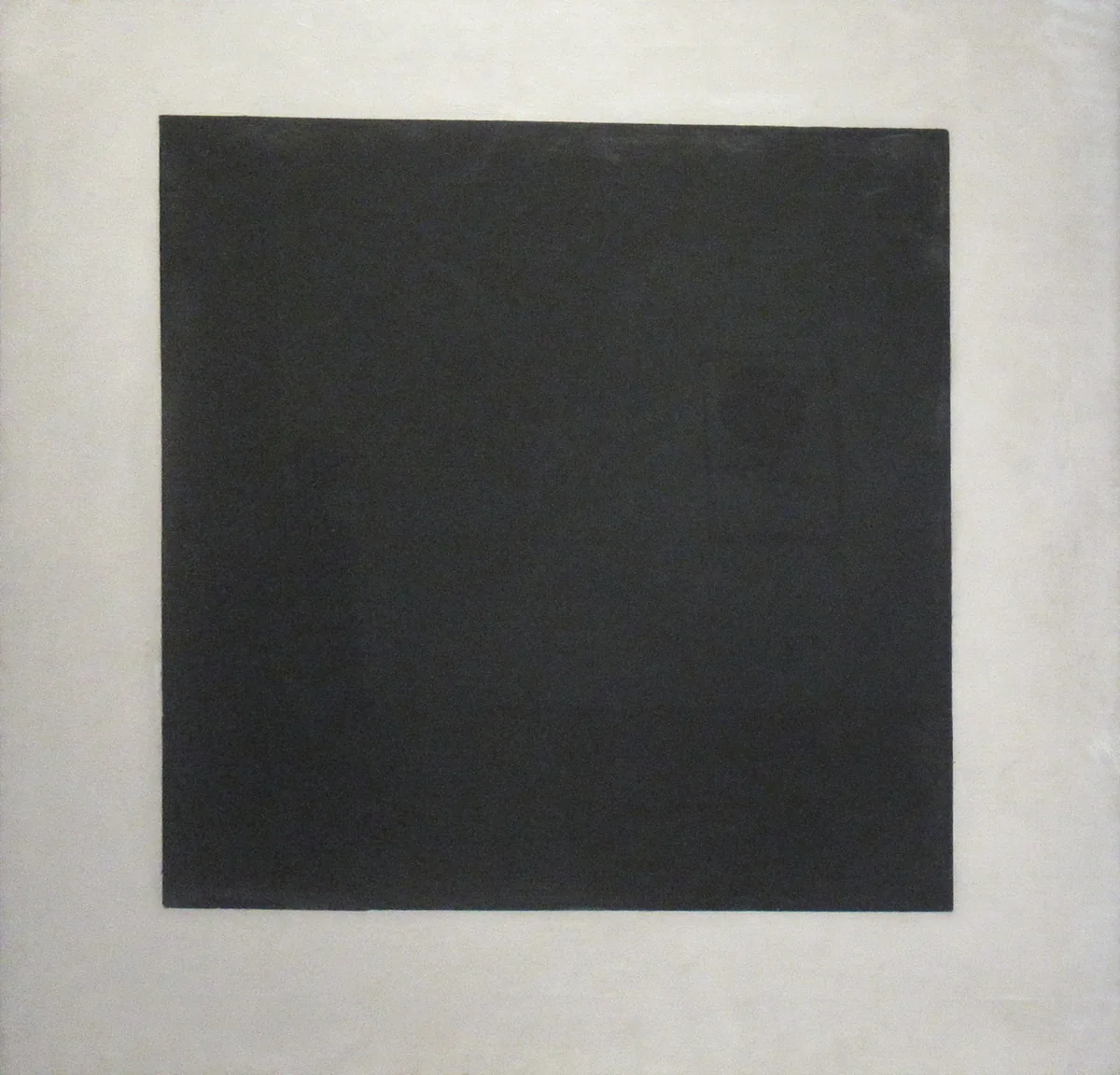

Looking at the two versions together, the difference is difficult to ignore. The earlier painting carries the marks of its own making and subsequent deterioration. The later one seems closer to the image most people remember: clean, direct, almost impersonal.
A fourth, smaller version followed in the early 1930s. Measuring just 53.5 centimetres square, it is now in the State Hermitage Museum. Its original purpose is less clearly documented. In 2002, the Russian businessman Vladimir Potanin purchased it for $1 million and donated it to the state, bringing another Black Square into a major public collection.
Four paintings, then. Similar enough to be recognized immediately, different enough to have separate histories.
I hesitate to call the later versions copies. The word suggests that the original contains everything important and that subsequent versions merely repeat it. Malevich's relationship with the square seems more complicated.
By the 1920s, the motif had become something like a personal emblem. Members of his UNOVIS group wore black squares on their clothing. Malevich sometimes used a small square in place of a signature.
It had travelled beyond the canvas.
When he died in 1935, the square appeared throughout his funeral. It was displayed near his coffin and reproduced on the hearse and other elements of the procession. A white cube bearing a black square was placed over his grave.
The image had become so closely associated with Malevich that it could stand in for the artist himself.
There is something curious about this transformation. The painter who wanted to free art from recognizable objects had created a form that became instantly recognizable. The black square could be repeated on a wall, a piece of clothing or a coffin, and still be understood as his.
The comparison with religious icons comes back to mind.
In icon painting, a sacred image can be repeated according to an established model without losing its significance. The image matters in ways that extend beyond the individuality of a particular painted surface.
Perhaps Malevich's square operated in a related way. This is an interpretation, rather than a documented explanation for every version he made. Still, the idea helps explain why repeating the motif did not necessarily diminish its importance.
Which One Is the Real Black Square?
And yet the first canvas remains different.
Its damaged surface contains the earlier paintings that Malevich covered. Its irregular geometry belongs to a particular moment in 1915. It was the object that hung in the corner at 0.10, confronting visitors with an image that seemed to deny everything painting had traditionally been asked to do.
For decades, that original was largely absent from public view, returning to wider visibility only in the 1980s. During much of that time, the idea of Black Square continued to circulate through reproductions and accounts of the exhibition.
The image survived without most people being able to see the object.
I keep returning to the contrast between the 1915 and 1929 paintings. One is cracked and uneven, carrying the evidence of earlier decisions beneath its surface. The other seems almost to erase that history. Both are Malevich's. Both present the same unmistakable form.
Perhaps that is why the cracks hold my attention.
They belong to the one thing that cannot be repeated precisely: the physical life of the first canvas. Beneath the black, the older colours are still there, visible through the narrow openings in the paint.
More than a century after Malevich covered them, they have begun to show themselves again.
Further reading
- State Tretyakov Gallery — Black Square (1915)
- State Russian Museum — Black Square (c. 1923)
- Tate — Five Ways to Look at Malevich's Black Square
- Factum Foundation — Digitisation of Malevich's Black Square
- The Art Newspaper — There Is More to Malevich's Black Square Than a Hidden Racist Joke
- The Art Newspaper — Malevich “Black Square” Goes to the Hermitage (2002)
Watch the film
Watch the Past the Frame film on Black Square
Related
- Who Painted the First Abstract Painting? Hilma af Klint, Kandinsky and the Problem of “First”
- Why Are Art Galleries White? The Hidden History of the White Cube