I was in my second year studying art history when I first read Wassily Kandinsky's Concerning the Spiritual in Art. At the time, abstract painting was something I struggled with. I could study a painting's composition, recognise its historical references and understand the period in which it was produced. But when confronted with a painting that offered no recognisable subject, I often found myself searching for an explanation that wasn't there.
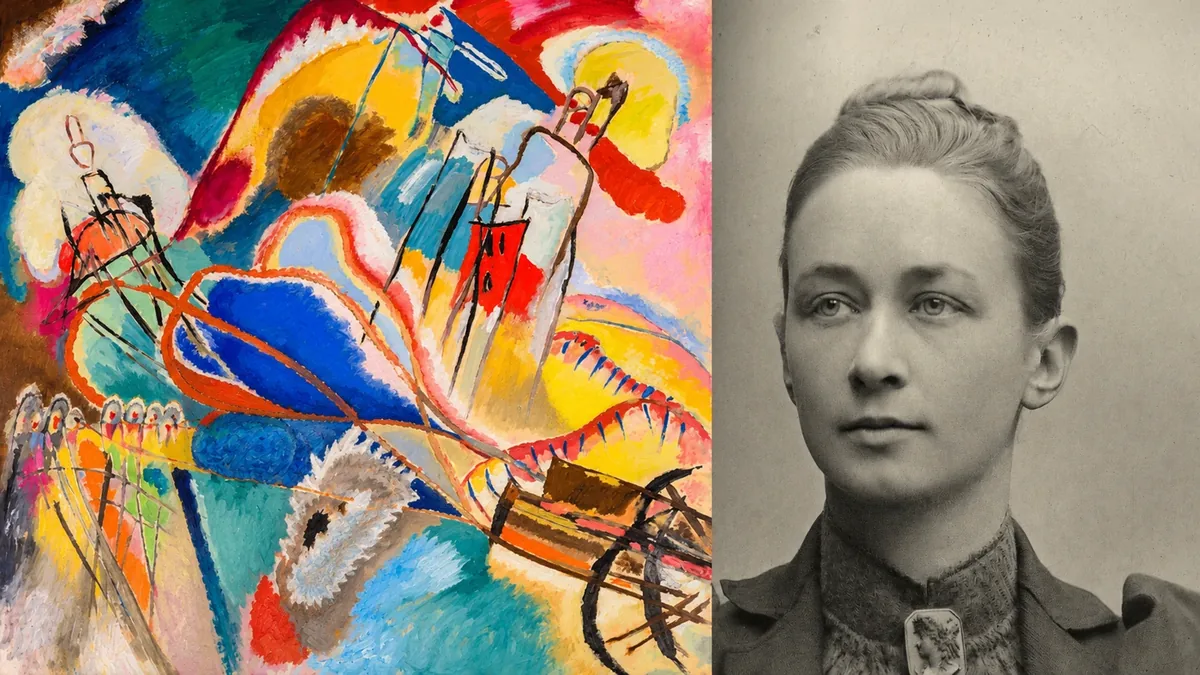
Kandinsky changed that for me.
His writing made me reconsider something I had taken for granted: that understanding a painting meant understanding what it depicted. His ideas about colour, music and inner necessity gave me an entirely different way of approaching a work of art. I began to appreciate that a painting could move me before I understood why.
He remains one of my favourite painters. I discovered Hilma af Klint somewhat later, but her work eventually acquired an equally important place in my understanding of art. Together with Kazimir Malevich, these two artists taught me something about meaning, about its apparent absence, and about the extraordinary things a painting can make us feel without depicting anything familiar.
Perhaps that is why I find the debate over who invented abstract painting both fascinating and slightly frustrating.
Is Kandinsky's Watercolour Really From 1910?
There is a watercolour by Kandinsky in the collection of the Centre Pompidou that was long regarded as the first abstract painting. Kandinsky signed it 1910. On the reverse, he identified it as an abstract watercolour from that year.
The museum, however, dates it to 1913.
Its composition suggests a connection with Composition VII, the monumental painting Kandinsky completed in the autumn of 1913. Whether the watercolour was an earlier exploration or a later study bearing an earlier date remains an interesting question.
Kandinsky certainly cared about his place in history. In 1935, he wrote to his New York art dealer, J. B. Neumann, asserting that Picture with a Circle, painted in 1911, was the first abstract painting of their time. The claim tells us something about how valuable originality had become in twentieth-century art.
He was hardly alone. Francis Picabia's Caoutchouc, another work now held by the Centre Pompidou, appeared in a Paris exhibition in 1930 with the date 1907. The museum considers around 1909 a more plausible date. Two celebrated artists, two disputed chronologies, and eventually two works in the same museum.
Meanwhile, something remarkable had been happening in Stockholm.
When Did Hilma af Klint Start Painting Abstract Works?
In November 1906, Hilma af Klint began the ambitious cycle we now know as The Paintings for the Temple. She was already an accomplished artist, trained at the Royal Academy of Fine Arts, with a career in portraiture and landscape painting. Her new work emerged from years of spiritual exploration, including meetings with four other women who called themselves The Five.
Within a relatively short period, her artistic vocabulary expanded into a world of spirals, circles, botanical forms and unfamiliar geometries. By 1907, she was producing The Ten Largest, paintings more than three metres tall that explored the stages of human life.
What draws me to these works is how strangely intimate they can feel despite their enormous scale. There is something almost organic about their abstraction. The shapes seem to grow, divide and unfold. They suggest a world in motion, with its own internal logic.
Did Anna Cassel Paint Some of Them?
Yet the story becomes more complicated when we consider Anna Cassel, af Klint's friend and fellow artist.
In a fascinating 2023 essay, researcher Hedvig Martin proposed that fourteen of the twenty-six paintings in the series known as Primordial Chaos may have been made by Cassel. Her argument rests primarily on differences in brushwork and the application of paint, with af Klint's notebooks providing limited supporting evidence. Martin acknowledges that the individual attributions cannot be established with complete certainty.
I find this particularly interesting because the recent rediscovery of Hilma af Klint has largely been told through the familiar idea of the neglected genius. Cassel's possible contribution asks us to look more closely at the relationships behind these paintings, and at how easily collaboration disappears when art history is organised around individual names.
There is another woman whose work complicates the chronology even further.
In 1871, the British spiritualist Georgiana Houghton rented a gallery on Bond Street in London and exhibited 155 of her spirit drawings. Their intricate layers of colour and tangled lines anticipate some of the visual qualities we associate with twentieth-century abstraction, although they arose from a very different understanding of art and spiritual experience.
Writing in The New York Review of Books in 2019, art historian Susan Tallman questioned the very premise that abstraction was something waiting to be invented. She argued that much of af Klint's seemingly unprecedented visual language had circulated for centuries in diagrams, book illustrations, prints and crafts. Art history's longstanding emphasis on easel painting had made these other visual traditions easy to overlook.
This brings us to the role of museums.
For decades, Hilma af Klint occupied little space in conventional accounts of modernism. Even the Museum of Modern Art's major 2012 exhibition, Inventing Abstraction, 1910–1925, excluded her work. Six years later, her exhibition at the Guggenheim became the most visited in the institution's history.
The paintings themselves had not changed. Their position within art history had.
By coincidence, just after I had finished making the accompanying documentary, af Klint made headlines again. On 19 November 2026, a small painting from 1920 sold at auction in Stockholm for a record $12.7 million. I hadn't known about the upcoming sale while researching the video, which made the timing all the more striking. I had spent days looking into how her place in art history had changed, and here was another chapter unfolding almost immediately after I had finished.
As an art historian working in a museum, I find these shifts endlessly interesting. Exhibition histories, collection policies, catalogues and even the dates printed on museum labels influence what generations of visitors come to regard as established knowledge.
So Who Was First?
So, who was first?
If we are concerned with the chronology of early twentieth-century painting, af Klint's work from 1906 deserves serious attention, alongside the possibility of Cassel's contribution. If we mean abstraction presented as modern painting in a major Paris exhibition, František Kupka's Amorpha, Fugue in Two Colours, exhibited at the Salon d'Automne in 1912, occupies an important place. And if we are considering the development of abstraction as a publicly articulated artistic philosophy, Kandinsky's contribution remains extraordinary.
I sometimes think about the student I was when I first opened Kandinsky's book. I wanted abstract art to make sense. Years later, I am much more comfortable with the idea that a painting might leave me with questions I cannot answer.
Kandinsky helped me discover the expressive possibilities of colour. Hilma af Klint made me curious about the invisible worlds an artist might attempt to describe. Malevich pushed me towards the uncomfortable possibility that even the simplest form could sustain an entire artistic philosophy.
Knowing which of them arrived first has never made me love their paintings any more or any less.
What matters to me is that each expanded the possibilities of painting, and, in doing so, expanded the possibilities of looking.
This essay accompanies the Past the Frame documentary, Hilma af Klint or Kandinsky: Who Really Painted the First Abstract Painting?
Sources and further reading
- Wassily Kandinsky, Concerning the Spiritual in Art, first published in 1911.
- Museum of Modern Art: Concerning the Spiritual in Art
- Centre Pompidou: Kandinsky, Sans titre (1913)
- Julia Voss: The First Abstract Artist? (And It's Not Kandinsky), Tate Etc.
- Andréi Nakov: Wassily Kandinsky, the First Abstract Painting
- Centre Pompidou: Francis Picabia, Caoutchouc
- Moderna Museet: Biography of Hilma af Klint
- Hedvig Martin: Who Created the Paintings for the Temple?
- Susan Tallman: Painting the Beyond, The New York Review of Books, 2019
- The Courtauld: Georgiana Houghton, Spirit Drawings
- MoMA: Inventing Abstraction, 1910–1925
- The Hilma af Klint Foundation: Biography and Chronology
- Bukowskis: Official auction announcement, 19 November 2026