Think back to the first time you saw the banana: yellow fruit, grey tape, white wall.
In 2019, Maurizio Cattelan's Comedian appeared at Art Basel Miami Beach: a real banana, duct-taped to a wall and sold in editions. Five years later, one edition sold at Sotheby's for about $6.2 million.
Art Basel Miami Beach 2026 opens in December, seven years after that first appearance, and we are still talking about the banana. It is easy to laugh at the story, especially once the price enters it. But the laugh hides something. An ordinary object became the centre of a debate that reached people who had never set foot in an art fair. Why does a place built for selling art end up deciding what the rest of us notice, and argue about?
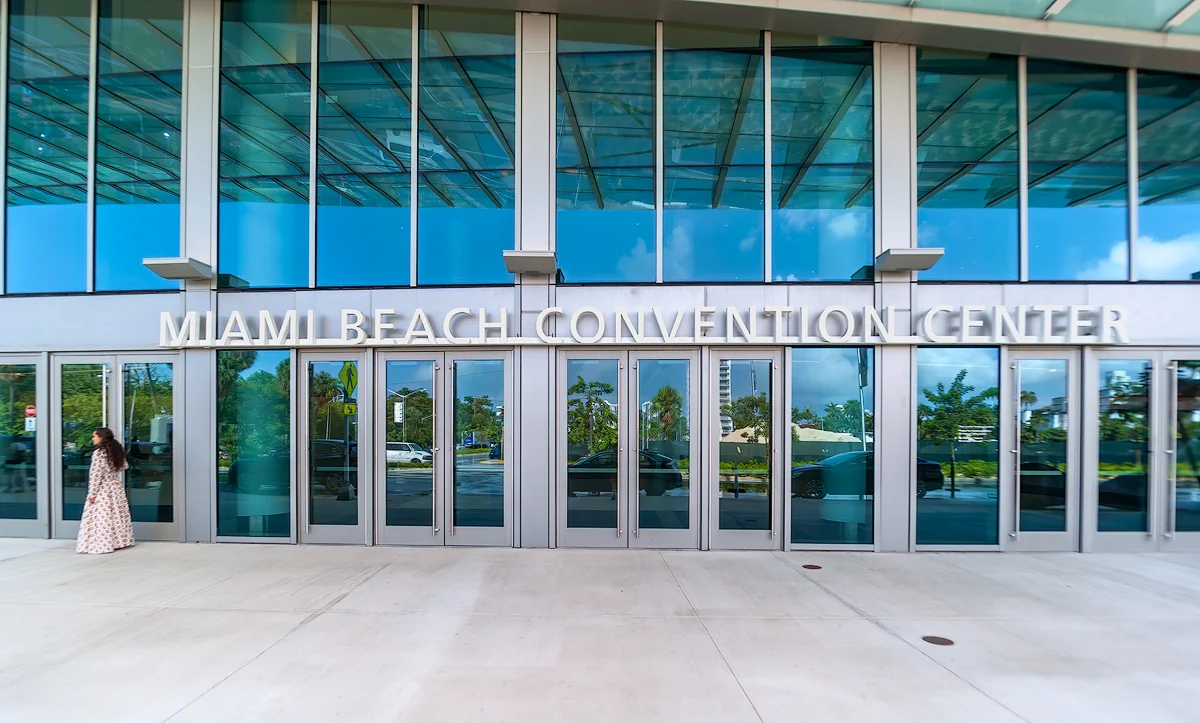
At a glance: Art Basel Miami Beach 2026 runs from 4 to 6 December at the Miami Beach Convention Center, with VIP preview days on 2 and 3 December and 272 exhibitors.
What Art Basel Miami Beach actually is
Art Basel Miami Beach is the American edition of a fair that also runs in Basel, Hong Kong and Paris, and, since February 2026, in Doha. Miami's connections with Latin America and the Caribbean have made it an international meeting point, and its December dates place it near the end of the art-market year.
In a museum, you can stand in front of a painting for as long as you like, read its label, walk away and come back. Nobody expects you to take it home. A fair works differently, even when nobody is talking about money.
An art fair is organised around galleries presenting and selling artworks. A biennial, such as the Venice Biennale, is built around a curatorial programme rather than commercial booths. Museum exhibitions are shaped by research and interpretation rather than the possibility of a sale. For a different kind of international art gathering, our guide to the 2026 Venice Biennale makes a useful comparison.
So when we look at photographs from Miami, we are not simply seeing art arranged for visitors. We are seeing choices galleries have made about what to bring, what to hang together and what collectors might want.
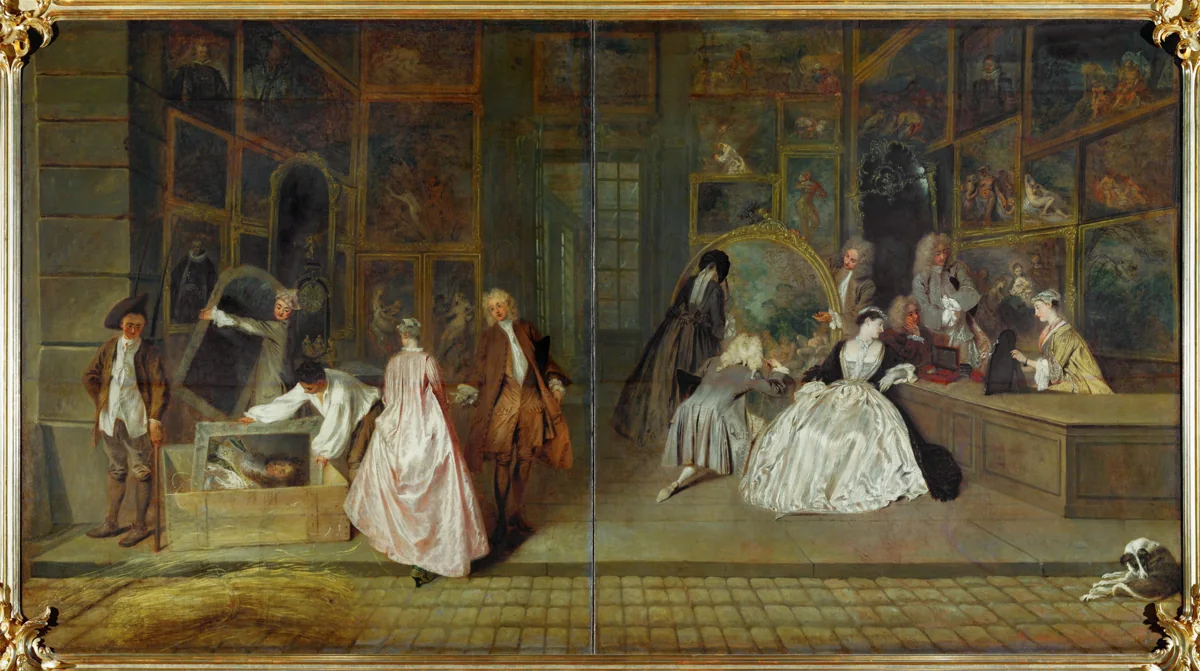
This is not a new arrangement. Around 1720, Antoine Watteau painted a shop sign for his friend Gersaint, an art dealer in Paris. It shows people leaning in to look at paintings, a dealer talking, and a portrait of the old king being packed into a crate as fashion moves on. Three hundred years later, the booth has air conditioning, but the questions are the same.

What's different at Art Basel Miami Beach 2026
This year's fair brings together 272 exhibitors from more than 40 countries and territories, and more than 30 galleries are taking part for the first time. The bigger change, though, concerns how the art will be arranged.
The organisers have reduced the fair's footprint by about 12 per cent and replaced five hospitality plazas with four. The main Galleries sector has 204 exhibitors, around 10 per cent fewer than last year. And the largest, most established galleries will be spread across the hall instead of grouped in one area.
On paper, that is logistics. In practice, the arrangement of a space shapes what we notice.
Remember the last exhibition you visited. Perhaps what stayed with you was a work you came across by accident, somewhere between the rooms you had planned to see. Where something hangs can decide whether we meet it at all.
At a commercial fair, that matters even more. A gallery on a busy route may have a very different week from one tucked away in a quieter corner.
These are plans, of course. We cannot know how visitors will respond until the fair opens. But even a floor plan is an argument about visibility.

Why fairs keep producing viral moments
Comedian is almost impossible to resist. You recognise the banana immediately. Then you learn where it was shown, what happened to it and, eventually, what it cost.
The price changes the conversation. A banana is something we buy without thinking. An edition of an artwork belongs to a different system, where authorship, recognition and scarcity shape what somebody will pay. That does not tell us whether Comedian is a good artwork. It does explain why its price became such a large part of the story. By the end of the 2024 auction, the money was almost as familiar a part of the work as the duct tape.
And then there is the eating. At the 2019 fair, a performance artist took the banana down and ate it. In 2023, an art student in Seoul did the same. In 2024, so did the buyer.
The price got the banana noticed. But attention at a fair works this way even when nobody is buying. I have thought about this often since visiting the art fair in my own city. What struck me was how many people seemed more interested in being seen than in buying art. The fair was still a good place to discover artists and understand the market, but at moments the artworks felt less like the reason for being there and more like backgrounds for Instagram photographs.
None of this is entirely new, and social media is not solely responsible. Art and social status have been tied together for centuries. But today, a photograph of somebody standing beside an artwork can travel much further than the artwork itself.
That may be why fairs are such fertile ground for viral moments. Dealers, collectors, journalists and visitors gather in one place, each for their own reasons. A photograph circulates, a price becomes a headline, and suddenly thousands of people are debating a work they have never seen in person.
What gets lost is everything else. We remember the strange object, the extraordinary price or the person who bought it. The works that might reward a longer look rarely get the same attention.
How to look at a fair if you're not buying
You do not need to travel to Miami to follow what happens there. Gallery websites, exhibitor pages and art-press reports reveal quite a lot, although never the full picture.
I would start with the galleries themselves. When you see a photograph of a booth, look past the work in the centre. Which artists are shown together? Is the gallery introducing someone new, or showing an artist it has represented for years? Even a small selection says something about how a gallery wants its artists to be understood.
Notice, too, what appears first. Once photographs of the redesigned floor begin to circulate, look at where works have been placed. What catches the camera? What seems positioned for maximum attention? Being photographed often is not the same as being artistically significant.
Be careful with prices. An asking price and a completed sale are different things, and neither tells you everything about the work. If a headline leads with a large number, look for the artist's name and try to understand the work before deciding what to make of the amount.
Finally, imagine the same artwork in a museum. Without a dealer nearby or the possibility of a purchase, would you approach it differently? Would you look for longer, or become more curious about its materials and history? The artwork stays exactly the same. The questions we bring to it change.
What remains after the banana
The curious thing about Comedian is how much we remember about everything around it: the wall, the tape, the price, the people who ate it. The work's history now includes all of those reactions.
Art Basel Miami Beach 2026 will produce its own stories. Some will be about sales, others about artists whose work deserves attention. Many will never reach anyone outside the fair.
The next time an artwork from a fair appears everywhere online, I wonder what would happen if we looked at it before learning the price.
Would we see the same thing?
Looking further ahead? Our 2027 art calendar follows the biennials, fairs and exhibitions still to come.
Further reading
- Art Basel, 29 September 2026: Art Basel announces 272 exhibitors and a reconfigured showfloor for its 2026 Miami Beach edition. Dates, participating galleries and floor redesign.
- The Art Newspaper, 29 September 2026: Art Basel Miami Beach scales down main gallery sector and floorplan for 2026 edition. Independent reporting on the smaller fair footprint.
- Art Basel, February 2026: Art Basel Qatar closes inaugural edition. Details of the inaugural Doha fair.
- The Art Newspaper, 21 November 2024: Maurizio Cattelan's duct-taped banana fetches $6.2m at Sotheby's New York.
- The Art Newspaper, 1 May 2023: Hungry art student eats Maurizio Cattelan's banana work. The second incident, at Seoul's Leeum Museum of Art in April 2023.
- The Art Newspaper, 29 November 2024: Crypto investor eats Cattelan banana he bought for $6.2m.