
In the Acropolis Museum in Athens, five young women stand in a row, holding up nothing. They are the Caryatids, carved to carry the roof of the Erechtheion. Their sister, the sixth, is in London. I remember standing in front of them for a long time, more moved than I expected. Whenever I visit a new city, I try to find its archaeology museum, and moments like that are the reason: it feels, for a second, like meeting the people who made these things.
But what exactly are we meeting? Many Greek and Roman sculptures were painted, yet the bare stone has become so familiar that colour can look like something added later. Over time, we've come to see the weathered look as the artist's intention, rather than what remains after centuries of loss.
When sculptors used many colours, it's called polychromy. The word unsettles the old myth of plain white marble. Colour mattered, not just as ornament but as part of the sculpture's meaning. The real challenge is learning to look again, and to let go of assumptions without replacing one fixed idea with another.
Painted Greek sculpture: the evidence on the surface
Let's start with a marble sphinx in the Met's collection. This Attic sphinx, from around 530 BC, once perched on a grave monument. If you look closely, there are traces of red, black and blue pigment. Not modern paint, but ancient colour clinging to the original surface.
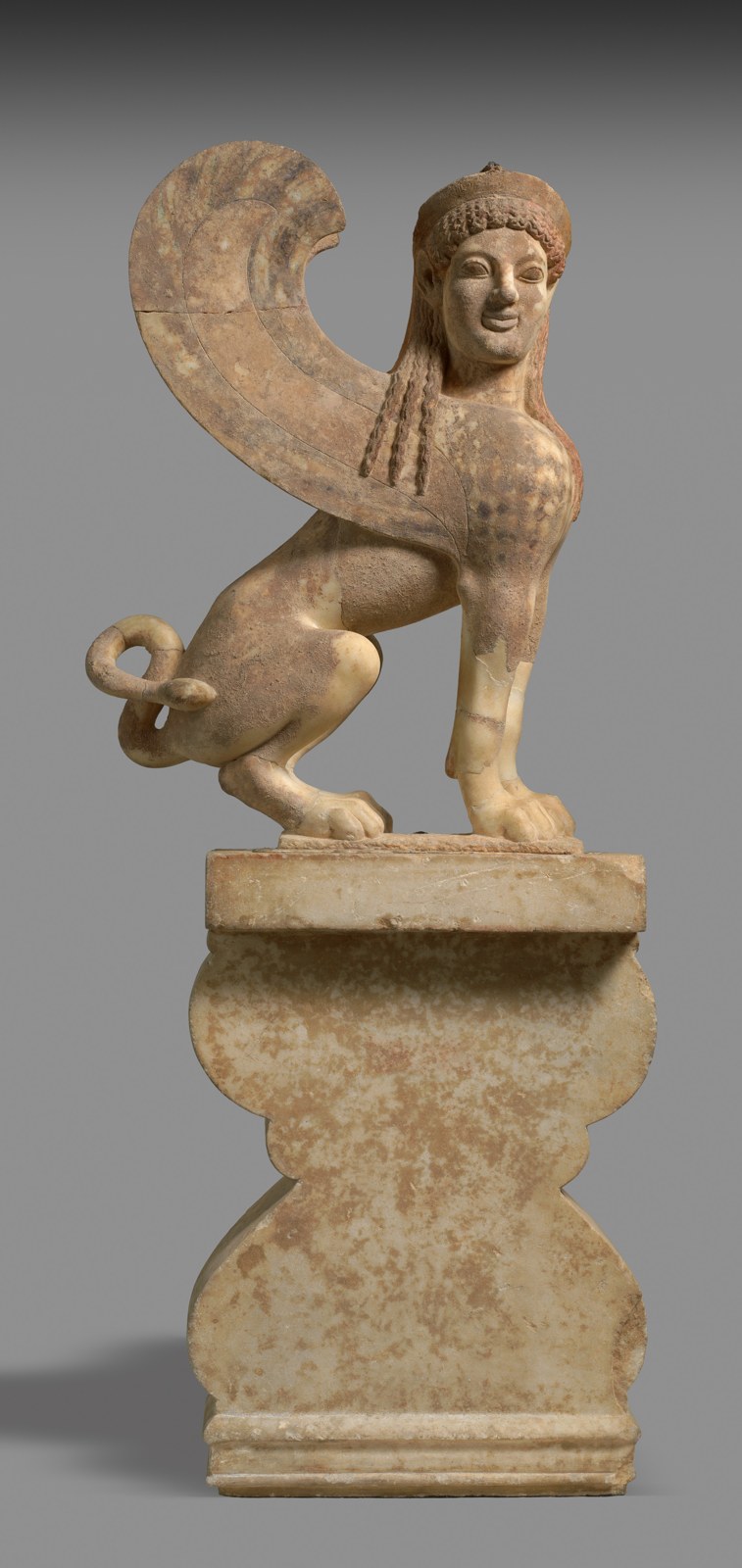
It's easy to be startled when a bright reconstruction stands next to a faded original. Each tells a different story. The original shows us what time has spared. The reconstruction invites us to imagine what once was, based on evidence and a measure of interpretation.
The Met's research on the sphinx reads a bit like a detective story. Its scientists found azurite blue on the feathers and Egyptian blue between them. They even corrected an earlier reading: traces once taken for green turned out to be blue that had changed over time. So the colour you see on an old surface isn't always the colour that was put there.
Honestly, that's more interesting than any neat 'before and after'. Nobody has finished studying this object yet.
A surviving colour is not always the final colour
Back in the Acropolis Museum, the Peplos Kore gives us a further warning. The museum describes the red on her hair as an undercoat beneath a brown finish. Look at her eyes and lips, and the red persists there too. And the dress? The museum's record describes it alive with animals, birds and riders, a complexity now mostly lost but still faintly visible.
So if a modern copy is painted only in the colours we see now, that decision needs to be questioned. A visible layer might once have been hidden beneath another. The smallest fleck could hint at a much grander design.
That's why any colour reconstruction should be read alongside the evidence. Where exactly is pigment preserved? Which patterns can we follow? Where have scholars filled gaps with comparison and interpretation? Ask those, and a reconstruction stops looking like a photograph of the past.
The Parthenon sculptures: cleaning and the loss of surface evidence
Colour fades not only with time and weather, but also at human hands. Cleaning, well-intentioned or otherwise, can strip away what little remains. The Parthenon sculptures, many of them in London like the sixth Caryatid, offer a particularly well-documented case.
In evidence submitted to the UK Parliament in 2000, the British Museum described unauthorised cleaning carried out over fifteen months in the 1930s. Copper chisels and carborundum were used on some of the sculptures, alongside the recommended soap and water. An internal inquiry followed, and members of staff left the museum. British Museum evidence, section 5
The record shows how abrasive the cleaning was. No one can say exactly how much ancient paint was lost. Still, it's unsettling: the very surfaces we hope will reveal the past have been changed by later choices.
The idea of white marble as an artistic ideal has its own long history. The cleaning of the Parthenon sculptures leaves us with a practical question. When you look at a statue in a museum, how much of what seems 'natural' is really the product of later interventions?
How scientists find ancient paint today
Today, scientific imaging lets us see what an ordinary camera can't. In 2023, researchers used visible-induced luminescence to map tiny traces of Egyptian blue on the Parthenon sculptures. Lit with visible light, the pigment glows in infrared, revealing its ghostly presence. The study also found traces of white and purple, colours long invisible to the naked eye.
An infrared image is evidence, not the whole picture. It tells you a pigment was there, not what the surface looked like with pattern, layers and sheen all in place.
That's the difference between finding colour and recreating it. We can be confident that a particular sculpture was painted and still not know quite how it looked when it was finished.
Looking again
There's no need to give up your fondness for white marble. Its glow, its cool surface, the way light slips along the carved details: these are still there to savour. But our admiration can become more thoughtful if we remember what has vanished.
A sculpture can be beautiful as it stands and still be incomplete as evidence. Both things are true. So instead of assuming bare stone was always meant to be seen, we can ask what the museum actually knows about its decoration, and how it knows it.
The next time you stand before ancient marble, pause at the label. You might discover a second history: pigment, gilding, cleaning, restoration. Then look again at the object itself. What traces of colour linger, even faintly? Where might pigment have survived, and where was it lost?
I still think about those five women in Athens, and their sister in London. What we meet in a museum is real. It just isn't the whole of what was made.
What have you been seeing as a finished work that might actually be a surviving layer?
Further reading
- The Met — Marble capital and finial in the form of a sphinx. Begin with the original: date, material, surviving pigment and the museum’s public-domain photograph.
- The Met — Ancient Greek Sculpture in Color. A detailed account of the sphinx investigation, including pigment identification and revised interpretations.
- Acropolis Museum — The Peplos Kore. A guide to the statue’s dress, decorative patterns and surviving layers of colour.
- UK Parliament — British Museum evidence: The Parthenon Sculptures. Section 5 records the museum’s account of the 1930s cleaning and subsequent investigations.
- King’s College London — Scientific analysis reveals the true colours of the Parthenon Sculptures. An accessible introduction to the 2023 study, with a link to the research paper in Antiquity.
Continue watching
Ancient Statues: Why Do We See Them as White?
Why Are Art Galleries White? The Hidden History of the White Cube